'%20fill='%233D5A80'/%3e%3crect%20width='48'%20height='24'%20transform='translate(36)'%20fill='%230B1324'/%3e%3cellipse%20cx='63.5'%20cy='21'%20rx='20.5'%20ry='21'%20fill='%233D5A80'/%3e%3crect%20width='20'%20height='8'%20transform='translate(44%2034)'%20fill='%230B1324'/%3e%3crect%20width='20'%20height='14'%20transform='translate(25%2028)'%20fill='%230B1324'/%3e%3crect%20width='7'%20height='8'%20transform='translate(44%2027)'%20fill='%230B1324'/%3e%3cpath%20d='M8%200H45V15C45%2026.0457%2036.0457%2035%2025%2035H8V0Z'%20fill='%230B1324'/%3e%3crect%20width='23'%20height='18'%20transform='translate(2%2021)'%20fill='%233D5A80'/%3e%3cpath%20d='M36.5824%2022.468V0.00341797H44.9899V22.468C44.9899%2033.2535%2036.2639%2041.9969%2025.4998%2041.9969H18.3662V33.5727H25.4998C31.6206%2033.5727%2036.5824%2028.601%2036.5824%2022.468Z'%20fill='%2398C1D9'/%3e%3cpath%20d='M25%208.31354H8.44746V16.6288H25V24.5116H8.44746V33.6086H25V41.9969H0V0.00341797H25V8.31354Z'%20fill='%23EEF8F9'/%3e%3cpath%20d='M49.039%206.11541C57.0641%20-2.066%2070.0444%20-2.03437%2078.0313%206.18616C78.113%206.27028%2078.1925%206.35632%2078.2726%206.44149L73.4907%2013.6479C73.1132%2013.1106%2072.69%2012.5962%2072.2194%2012.1119C67.4274%207.17966%2059.639%207.16024%2054.8239%2012.0688C50.0089%2016.9776%2049.99%2024.9558%2054.7818%2029.8881C59.5739%2034.8203%2067.3623%2034.8397%2072.1774%2029.9312C73.8015%2028.2754%2074.8785%2026.2695%2075.4107%2024.15H64.5257V16.8H83.5879C84.9144%2023.4888%2083.0382%2030.7098%2077.9622%2035.8846C69.9372%2044.066%2056.9569%2044.0343%2048.97%2035.8139C40.9831%2027.5933%2041.014%2014.2969%2049.039%206.11541Z'%20fill='%23EEF8F9'/%3e%3c/svg%3e)
TourWay

TourWay
Your Time, Your Tour, Your Way
6 month long Junior capstone project for self-guided, custom campus tours, starting from initial concept to functional demo and formal presentation.
Septemeber 2024 – March 2025
My Roles
Lead Project Manager
Front-End Developer
UX Researcher
Where Our Journey Begins
During our fourth year at Drexel University, our UX design capstone required a 6-month group project with four other students. As project manager, I directed project goals, documented progress, and contributed to design, development, and research from concept to final product.
Our first was identifying a problem that was beneficial to solve, feasible within our timeframe, and provided a unique solution to a common issue. With two team members working as Drexel tour guides, one problem became immediately clear.
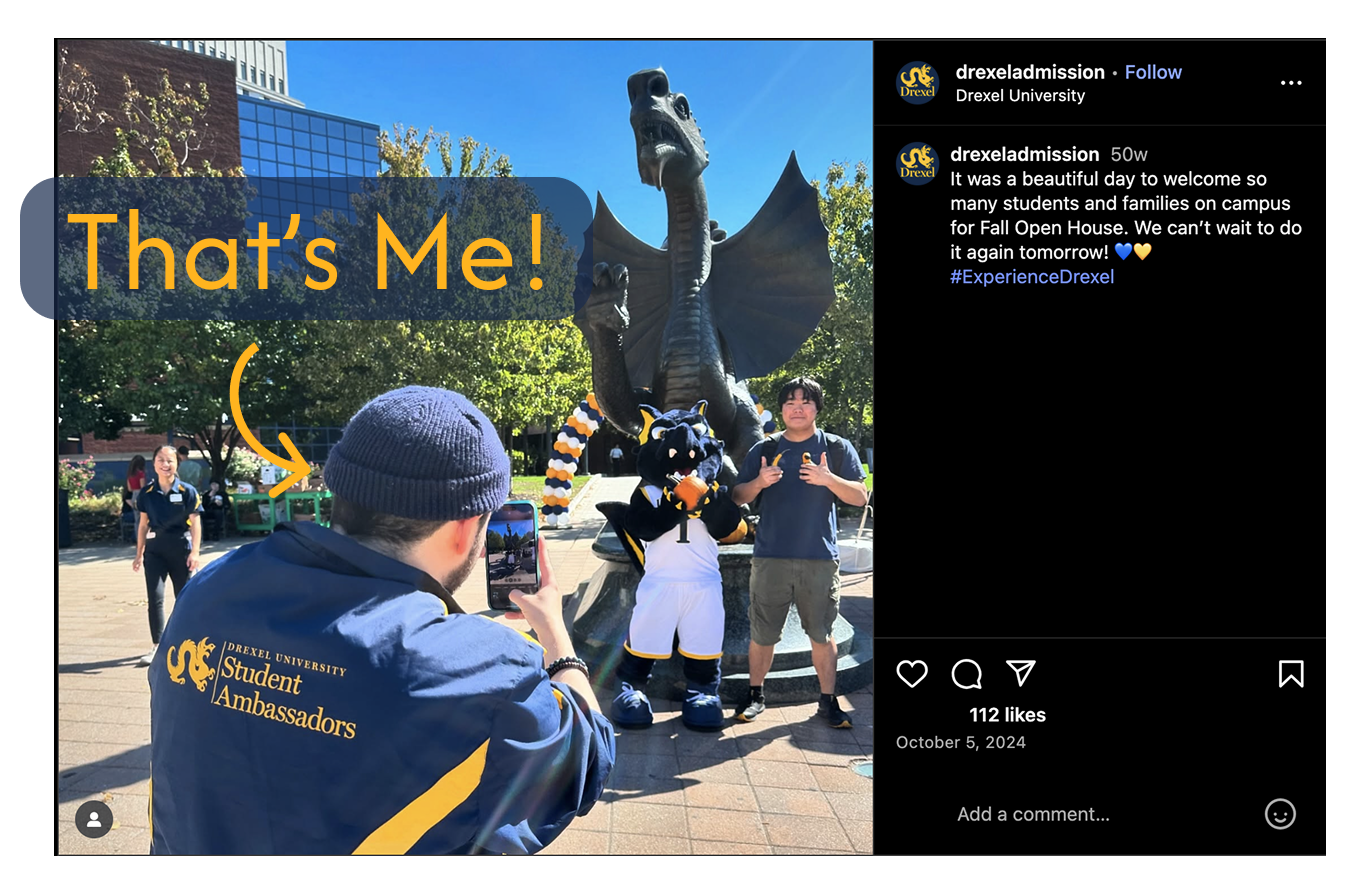
Me featured on Drexel's Instagram account, working an Open House
Having been a Drexel tour guide since freshman year, I've witnessed firsthand the frustrations that prospective students and their families experience during university tours.
Why can these tours be so frustrating? Everyone in a tour group has very different needs:
- Academic and extracurricular interests vary wildly
- Financial circumstances shape decisions
- Living preferences matter
- Schedules and locations create constraints
- Time and budget to travel and tour differ vastly
Diving Deep into Research
While my teammates and I had personal insight, we needed objective validation
Secondary Research
Key takeaway: Students prioritize student life, while parents focus on financial costs during the college search journey.
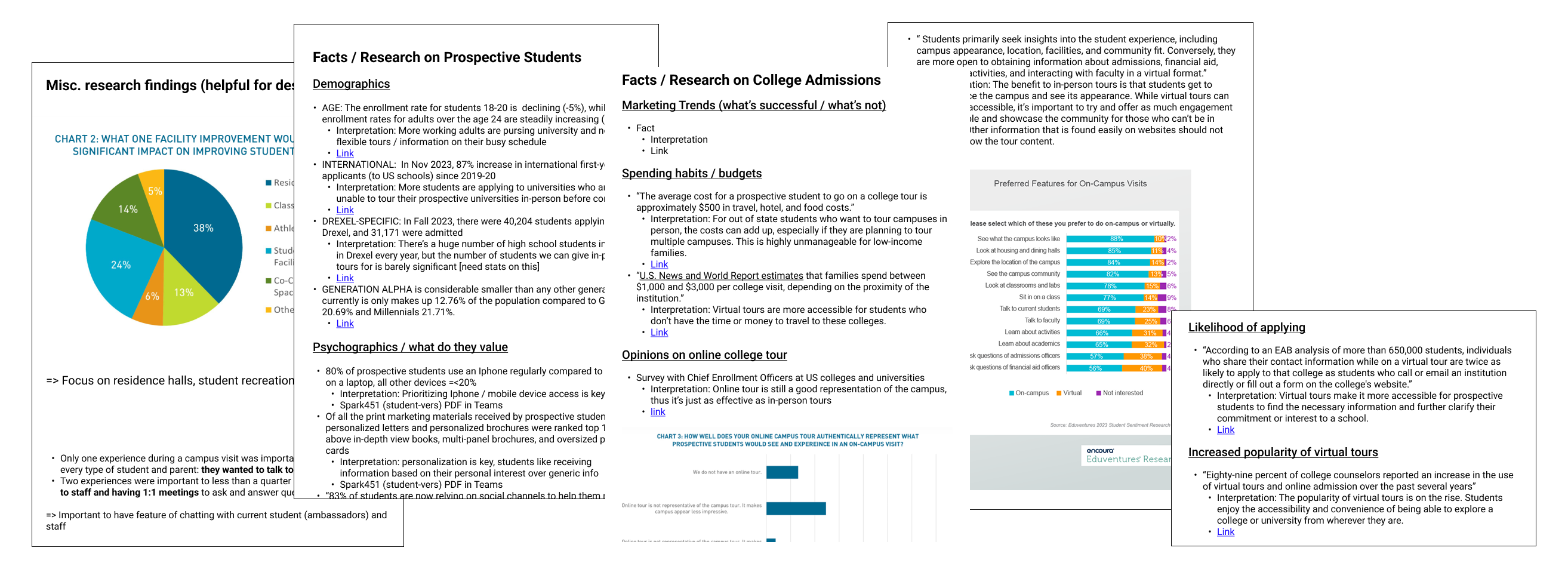
A compilation of some secondary research notes
Prospective and Current Student Surveys + Interviews
Key takeaway: Customizability features intrigued students the most. Students would prefer a custom self-guided tour over a standard tour guide-led tour
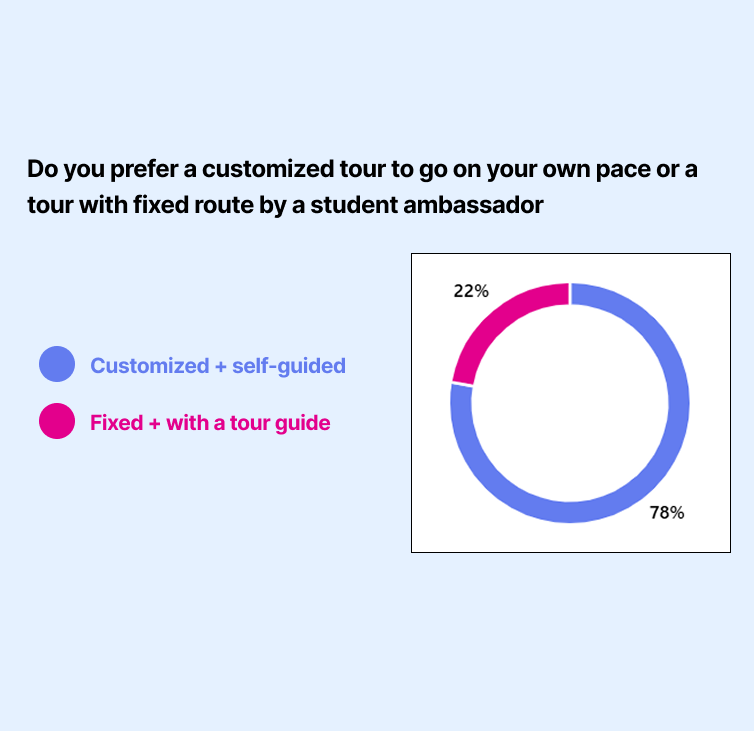
Survey results: Fixed Route vs Self-guided custom
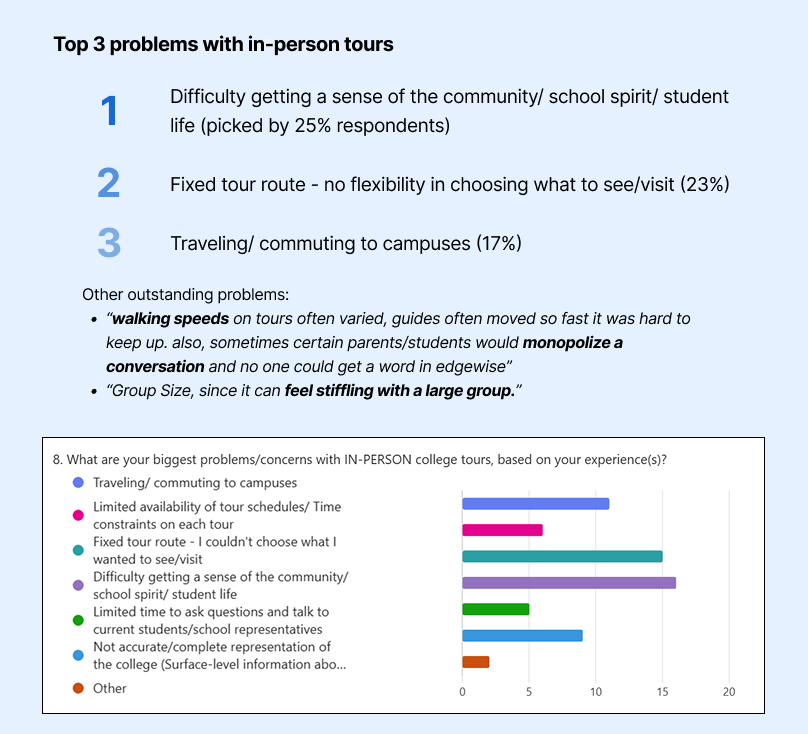
Survey results: Top problems with in-person tours
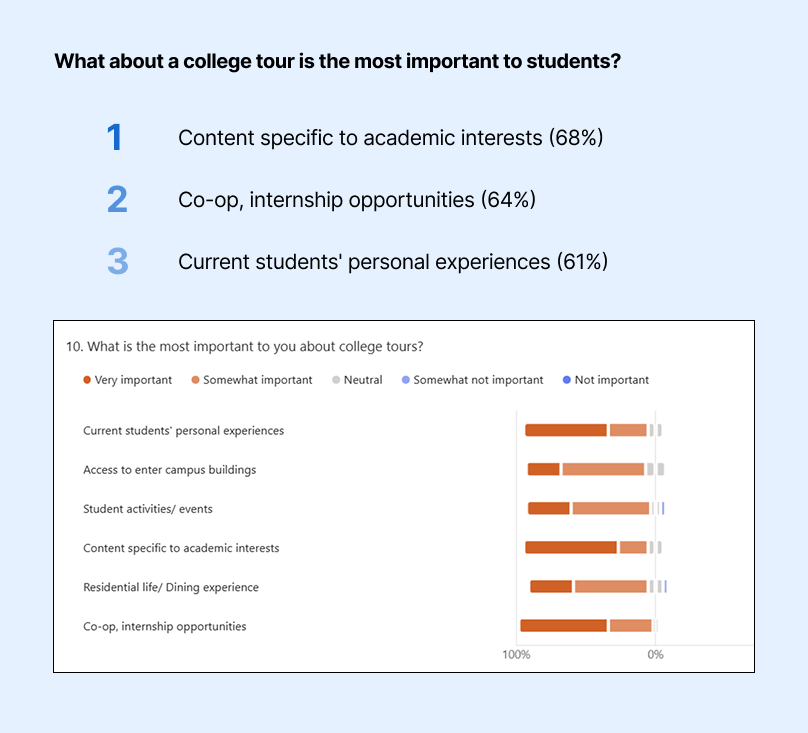
Survey results: What is important on tour?
Prospective Student Card Sort
Key takeaway: We discovered a vast gap between the priorities of prospective students who felt confident in their desired major and college preferences versus uncertain students unfamiliar with the entire college search process and their future aspirations.
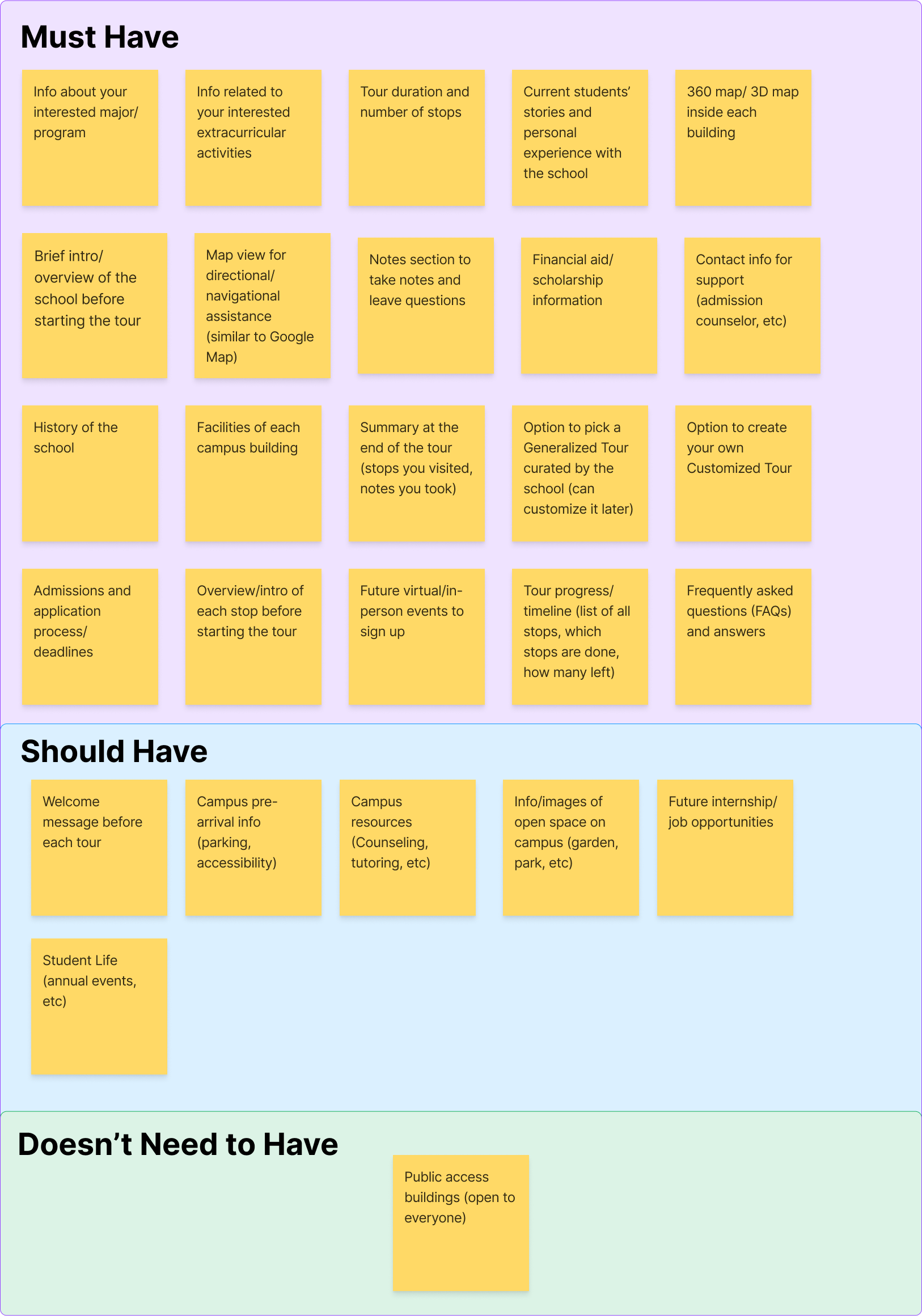
Card sort participant 1
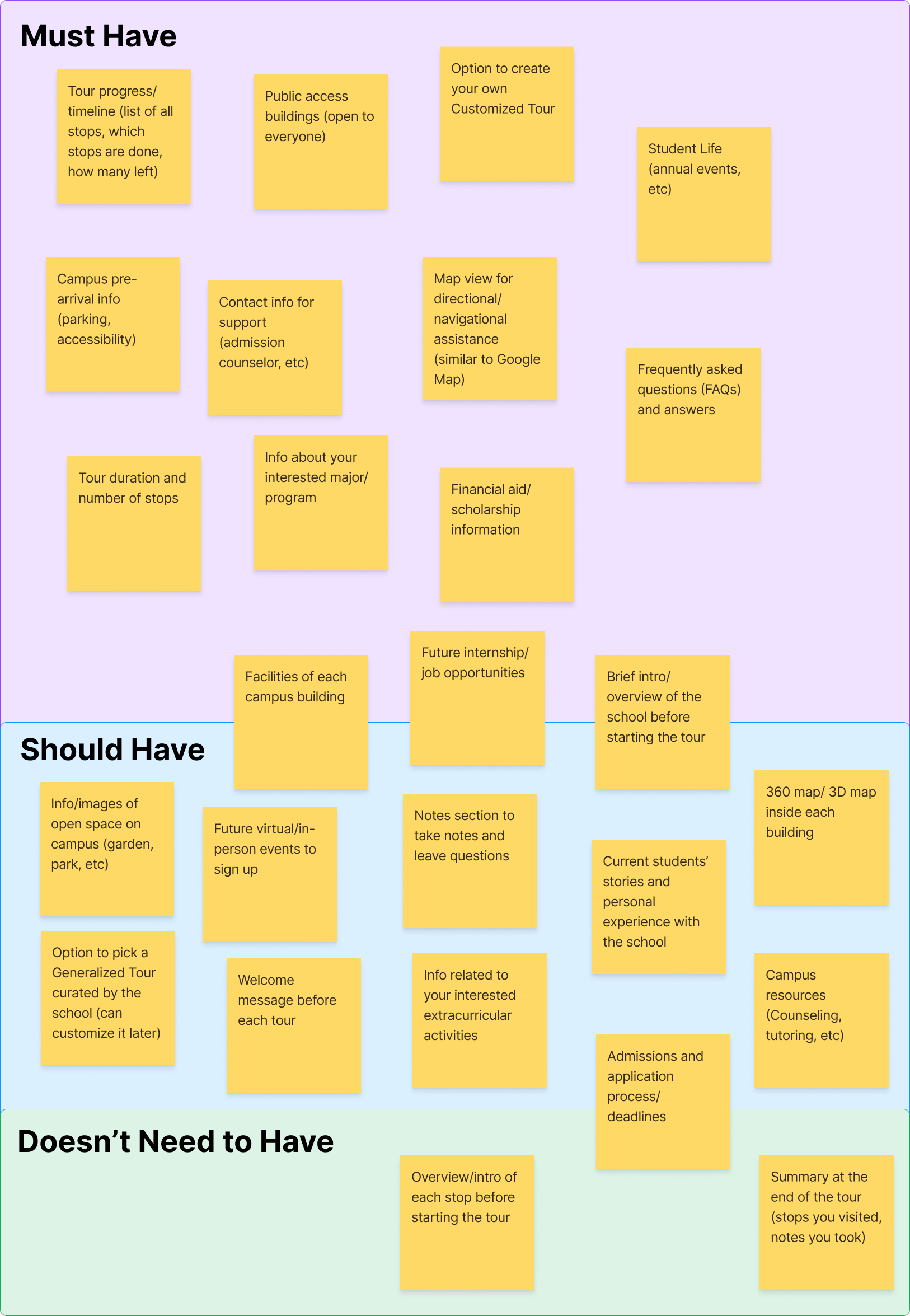
Card sort participant 2
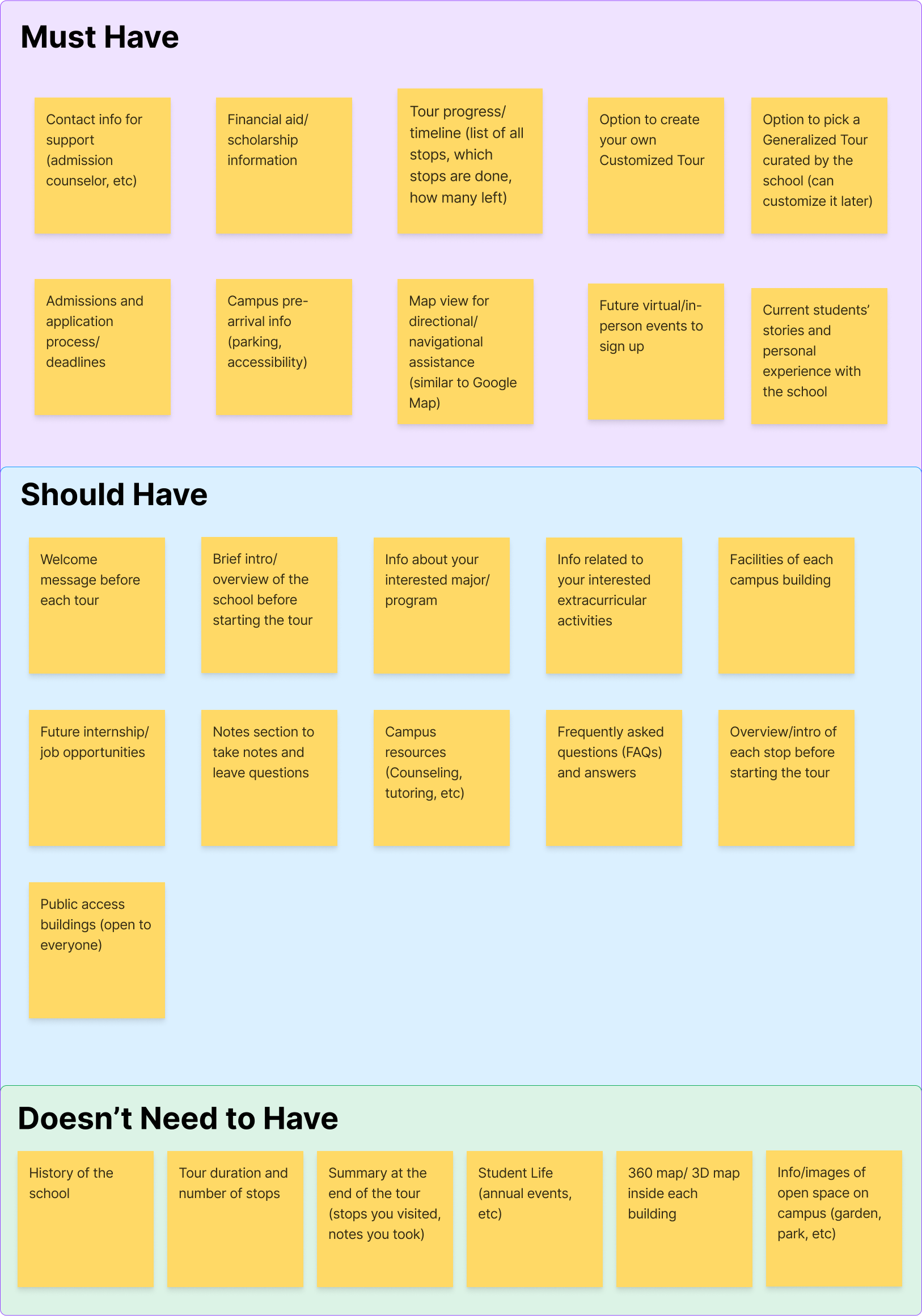
Card sort participant 3
Competitor Analysis
Key takeaway: Current solutions prioritize either flexibility of virtual tours OR customizability—but not both.
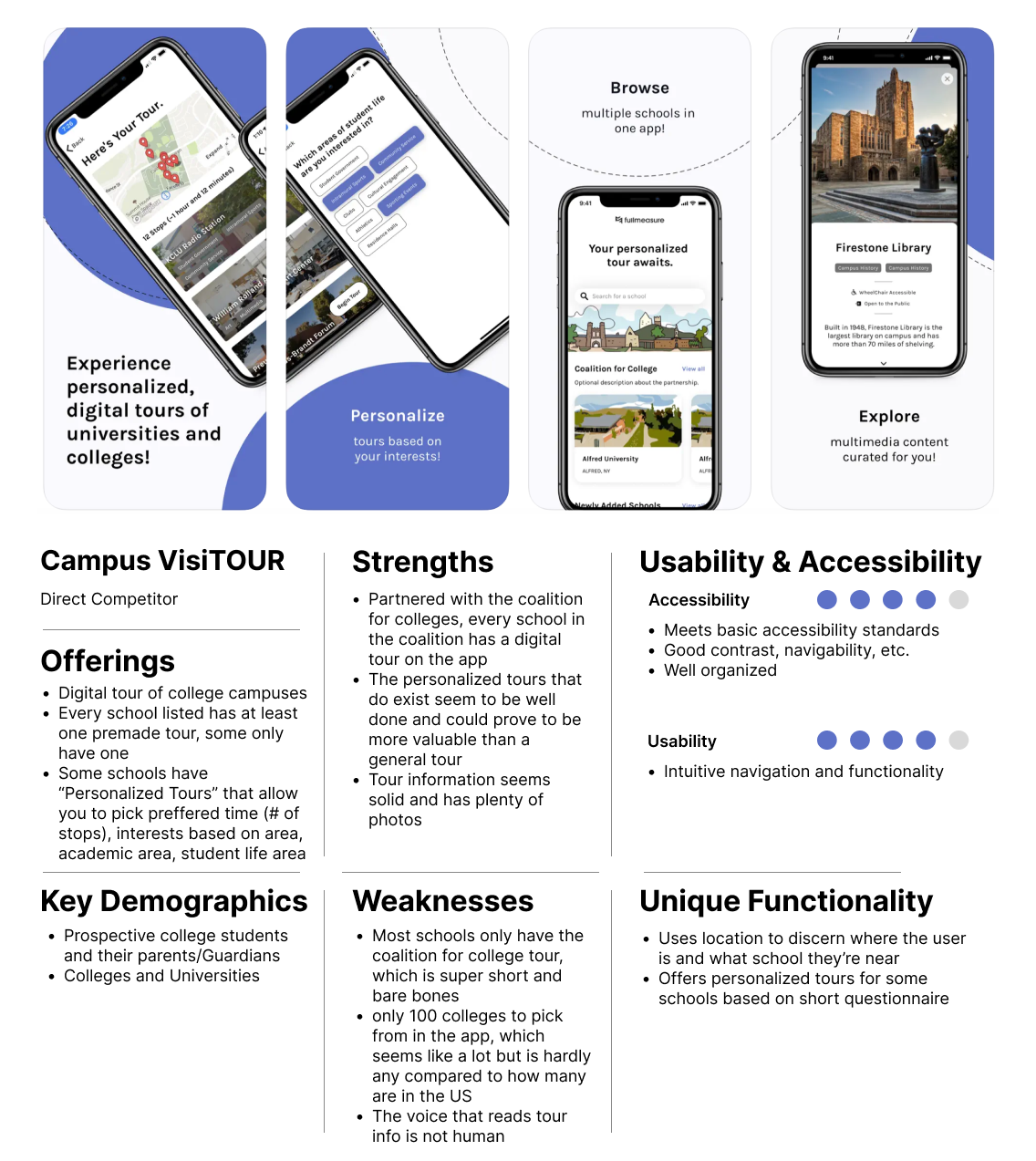
Competitor: Campus VisiTOUR
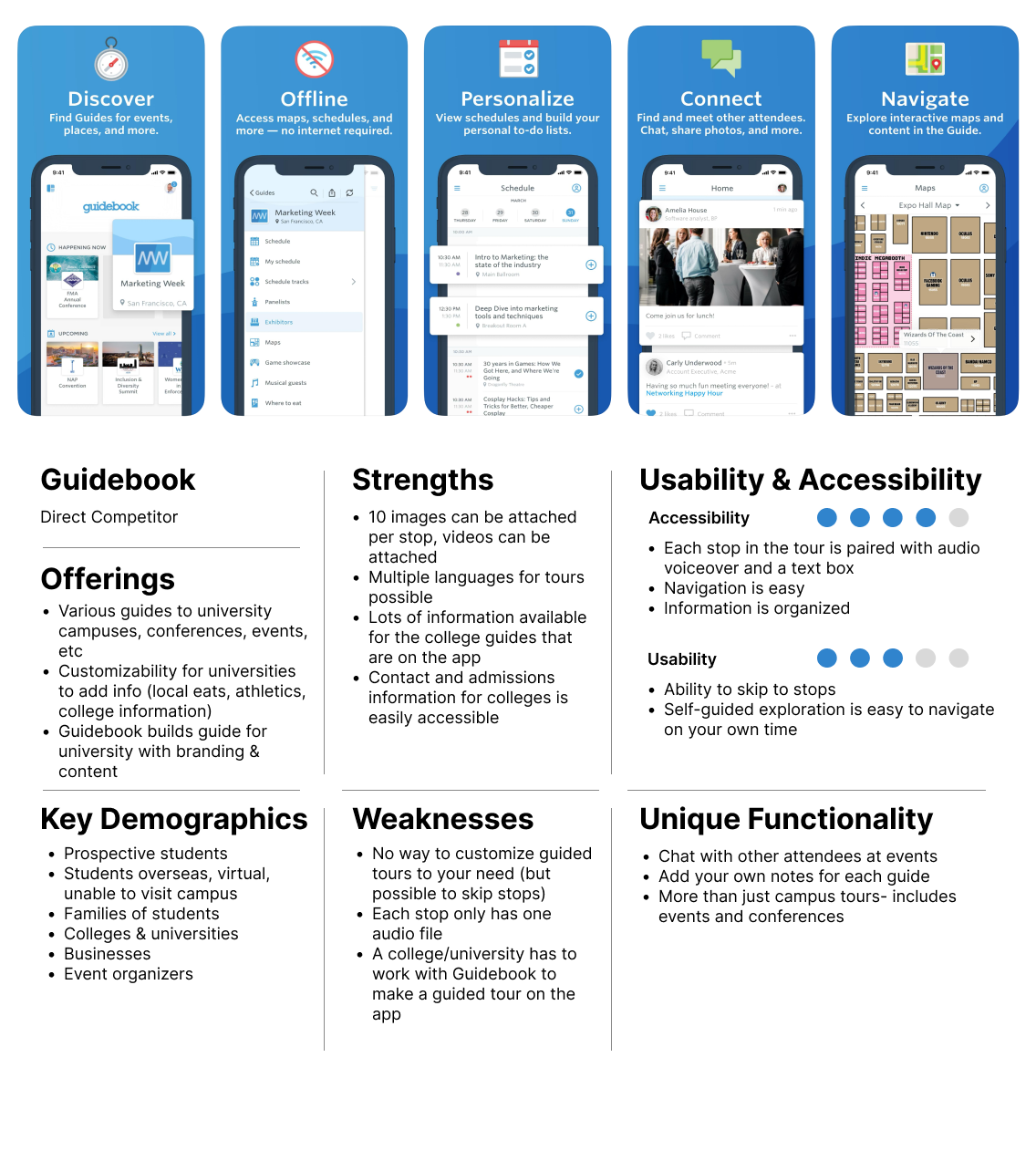
Competitor: Guidebook
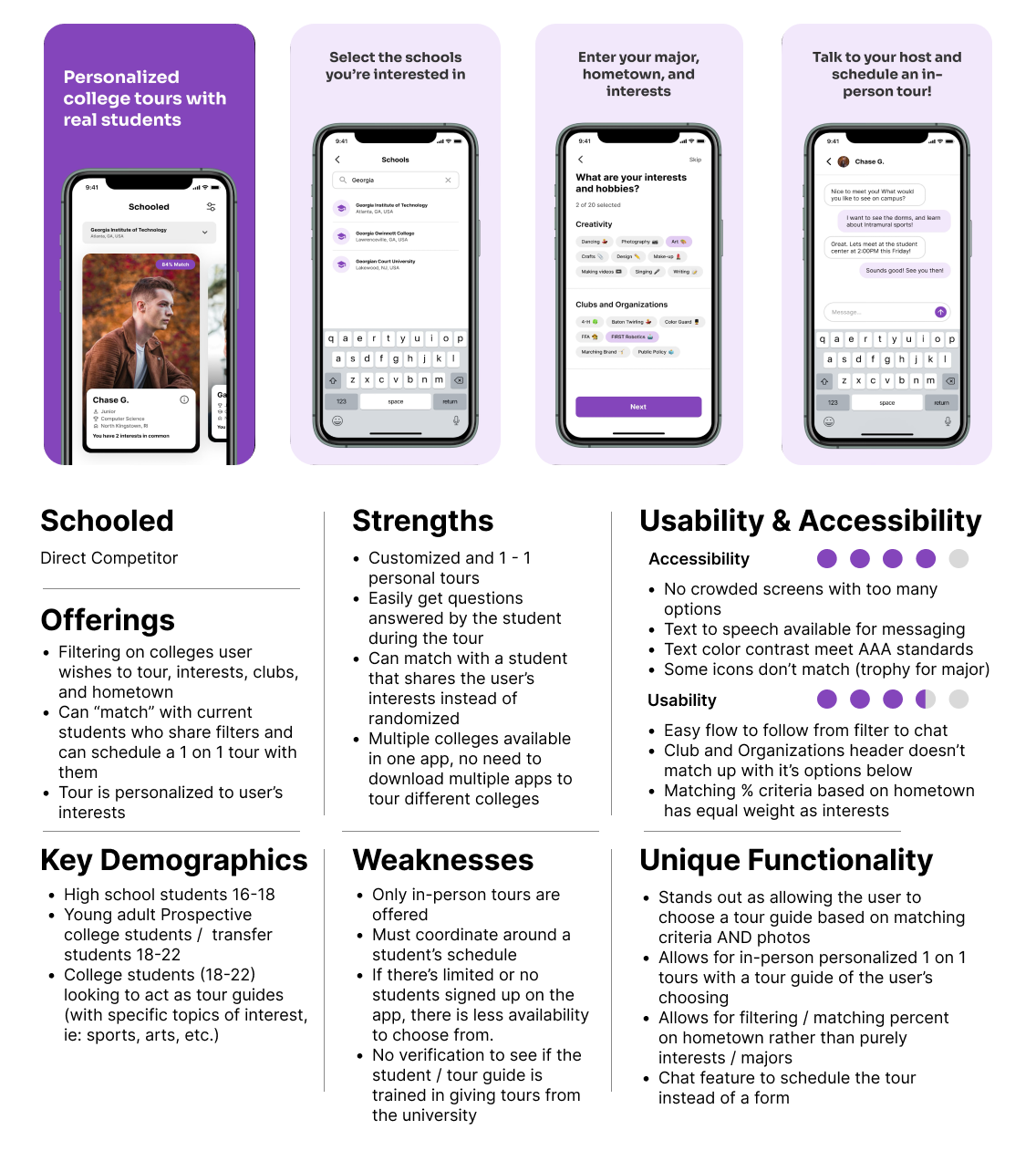
Competitor: Schooled
Key Issues Discovered
The top 3 problems with in-person guided tours:
- Traveling/commuting to campuses
- Fixed tour routes with no flexibility in choosing what to see
- Difficulty gauging community, school spirit, and student life
Challenge in sourcing varied prospective students
Finding a variety of prospective students for our survey was tough and limited to those interested in Drexel. This created potential bias since Drexel tends to attract more STEM career-orientated students.
The Student Tour Guide Survey Solution
We surveyed college tour guides instead—each guide represents hundreds of student interactions and can identify common patterns, questions, and frustrations.
Our guide network: Boston University, Susquehanna University, Ithaca College, Northeastern University, and Drexel Univeristy
Why this worked: Rural + urban campuses, liberal arts + professional + research universities = comprehensive understanding of diverse student needs.

Universities of student ambassadors who participated
Designing for Everyone
How do we simplify complex college information while supporting both the detail-oriented super user AND the overwhelmed undecided student?
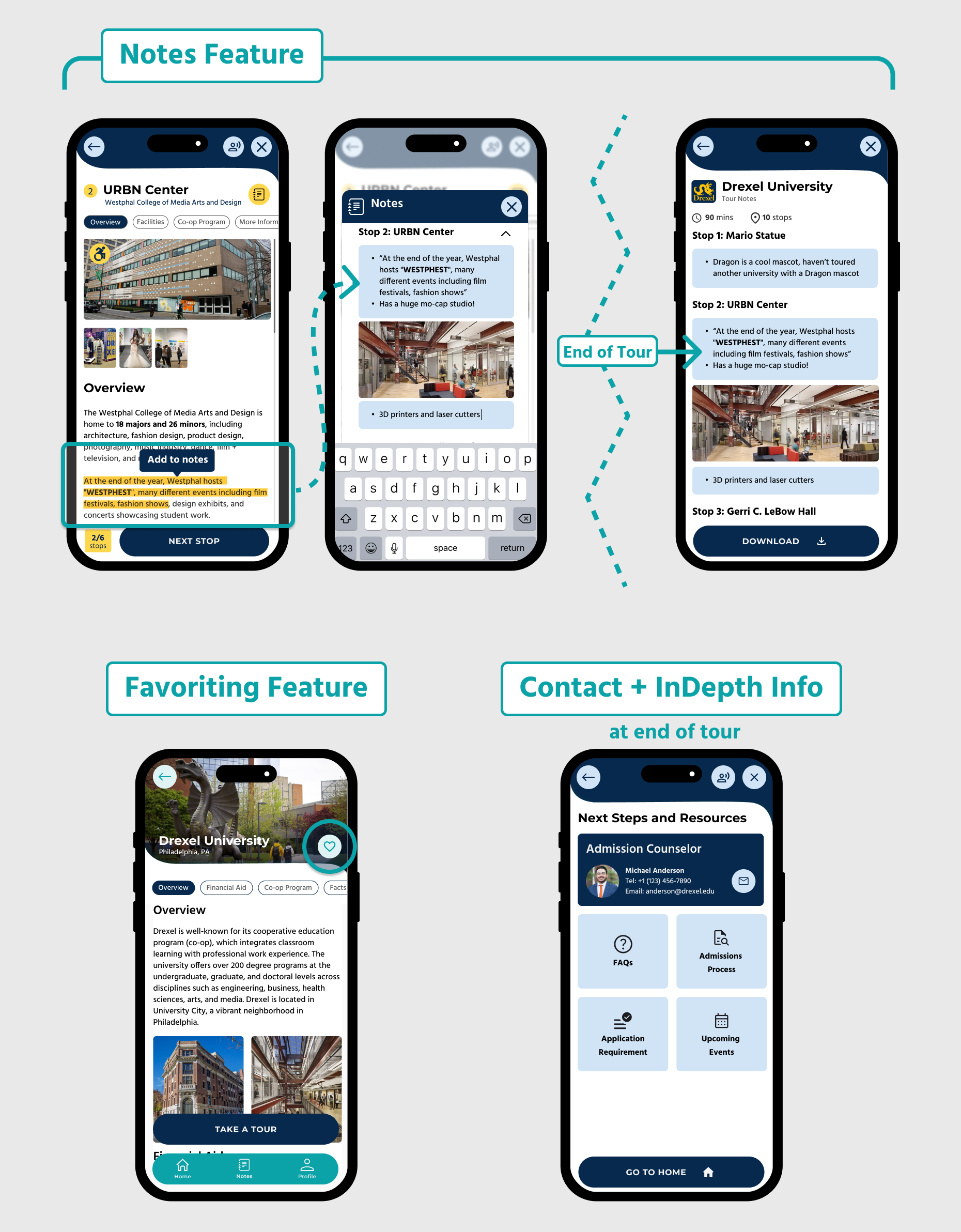
Exportable notes feature, university favoriting, contact and application links
For Super Users
This screen shows our exportable notes feature, university favoriting, contact and application links
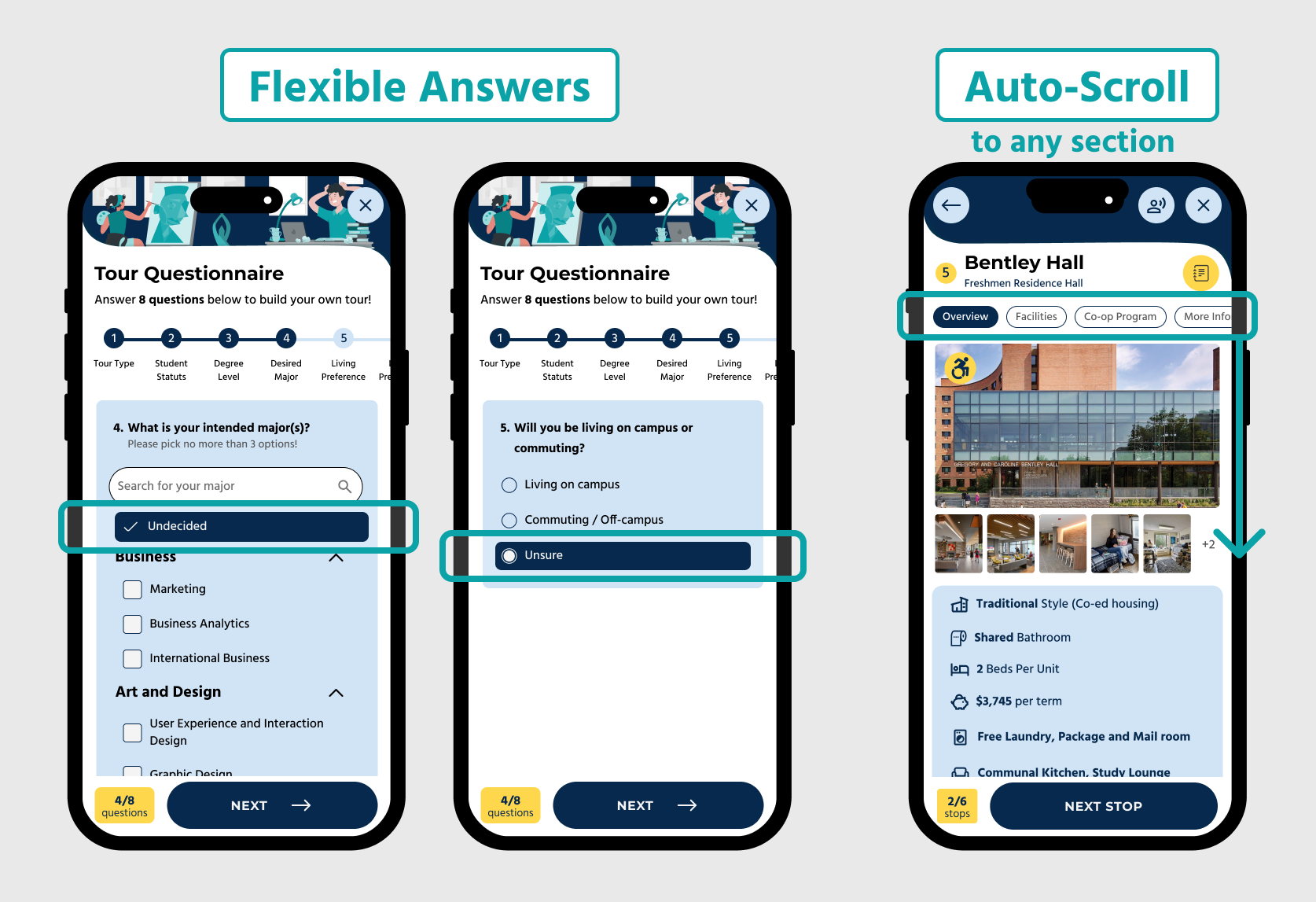
Undecided options and easy auto-scroll
For the Unsure Users
It's okay to not know how to answer. Many questionnaire questions like extracurricular interests or living preferences can be answered with 'unsure,' and users can easily skim tour stop information with autoscroll buttons and go at their own pace.
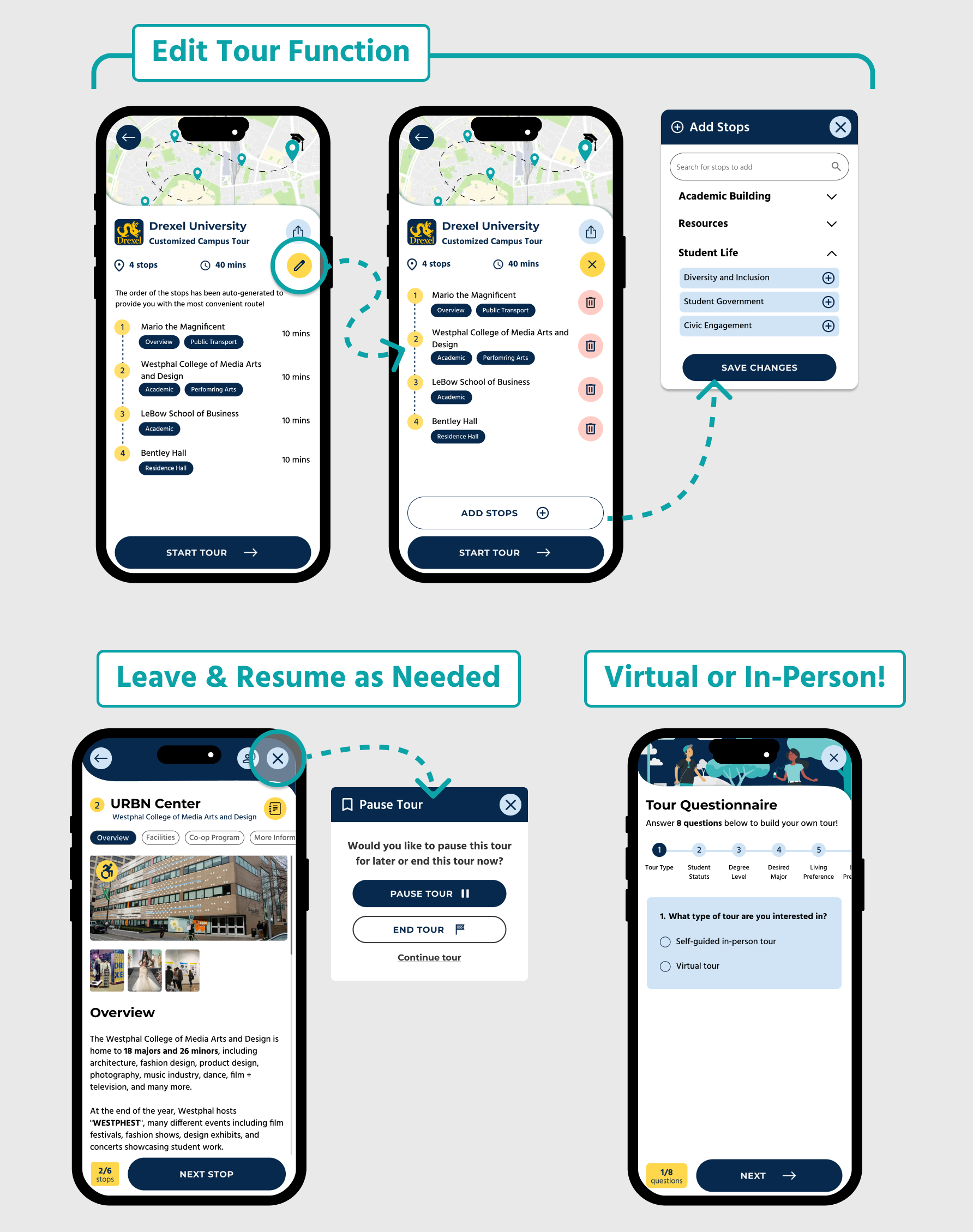
Edit tour functionality, pause tour whenever, and virtual options
For Everyone
Maximum forgiveness. Stops can be skipped and revisited, generated tours can be edited, paused and resumed from anywhere, and there's no dependence on geographic location to see stops. The college process is stressful enough, so this should be as stress-free as possible.
Stop View
- Initial concept: Multiple sections per tour stop to break up information, ability to go back and to next stop
- Problem: Users wanted major-specific content and back button way too large
- Solution: Major selected in questionnaire autoselected in section below, but user has the option to see details on all majors in college, next stop button given more visual weight
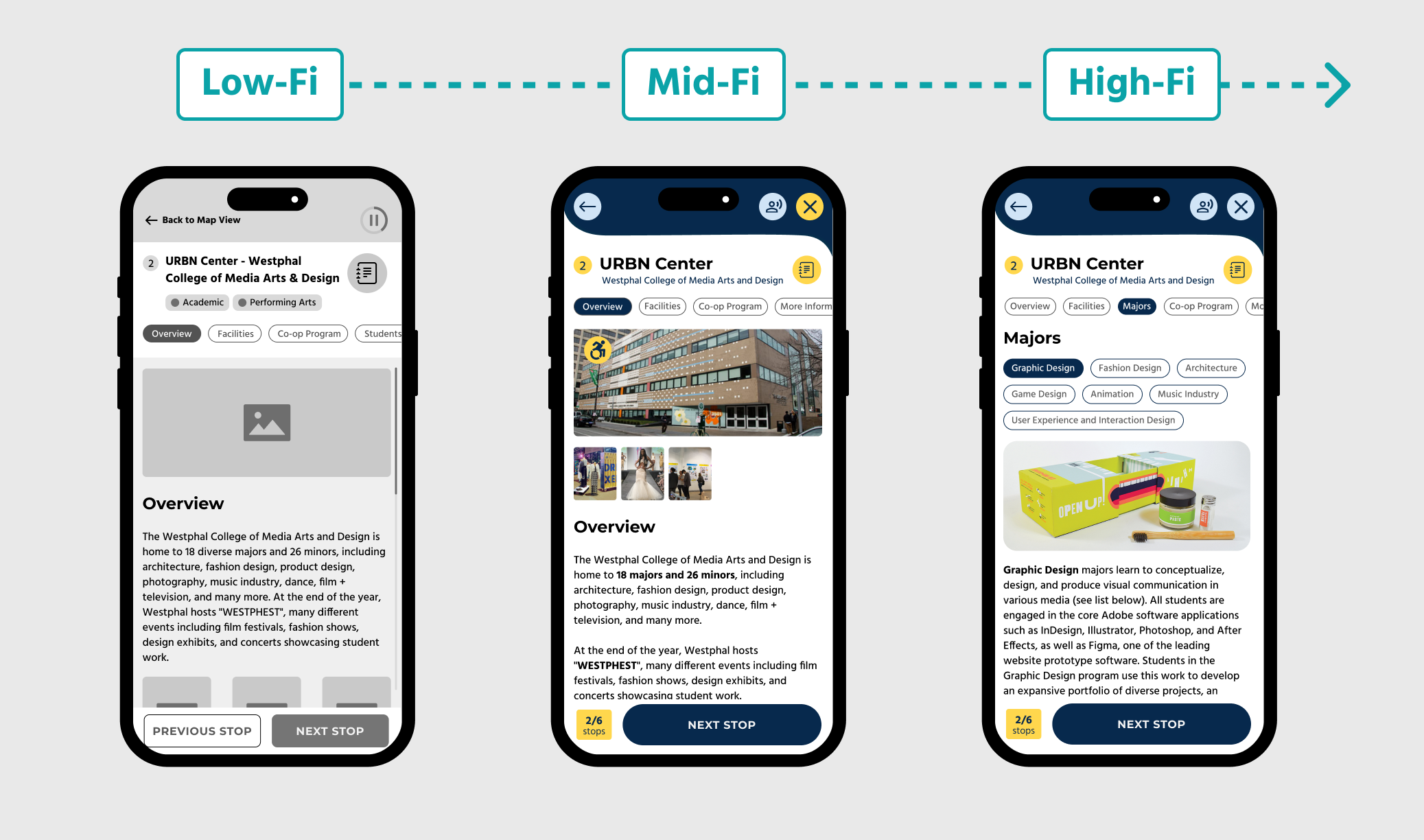
Low-Fi to High Fi Stop Screen
Map View
- Inital Concept: Map view with all buttons on display, directional assistance
- Problem: End tour too large, reliance on in person geo-location to continue, way too many buttons, hard to hit back button
- Largest CTA should be next stop, not reliant on location for flexibility, removed notes button on map
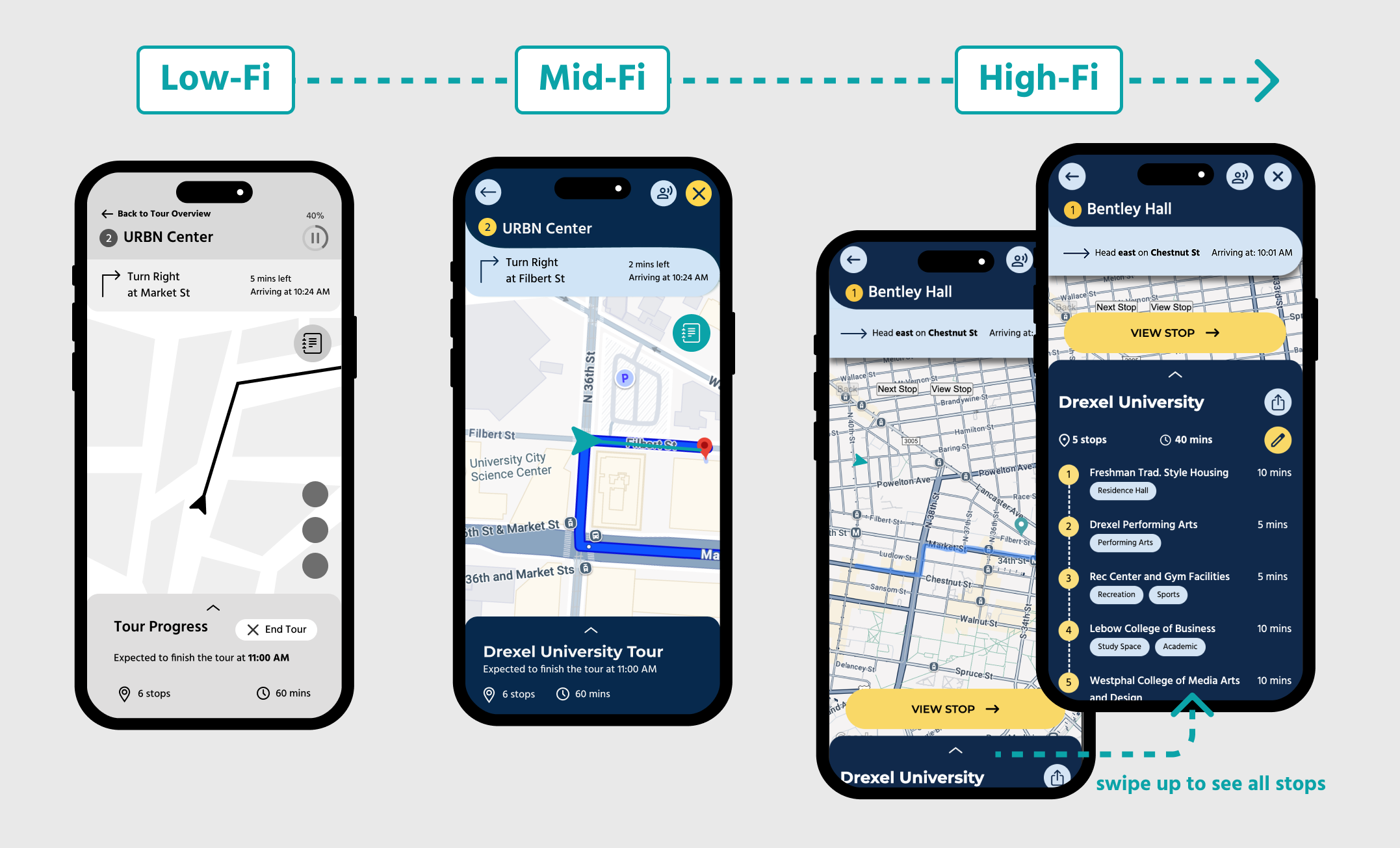
Low-Fi to High Fi Map Screen
Final Functional Demo
Developement
TourWay's functional prototype uses React.js for component-based UI and Supabase for backend storage.
Database structure:
- Questionnaire questions and answers
- Tour stops (names, locations, IDs)
- Stop and major-specific content (imagery, text, features)
Dev flow:
- Select university from homepage → pulls general data
- For custom tours: gated prompt for users to log in or sign up, then complete questionnaire
- Answers map to specific stops using prefixes (e.g., if a student chooses a design major, they get assigned "AWCAD" which maps to the design building stop)
- Duplicates are removed and generates tour with calculated duration and stop order (e.g., choosing two majors in the design college results in one design building stop, not two)
- Seeing the full list of tour stops, users can edit by adding/removing stops before starting tour
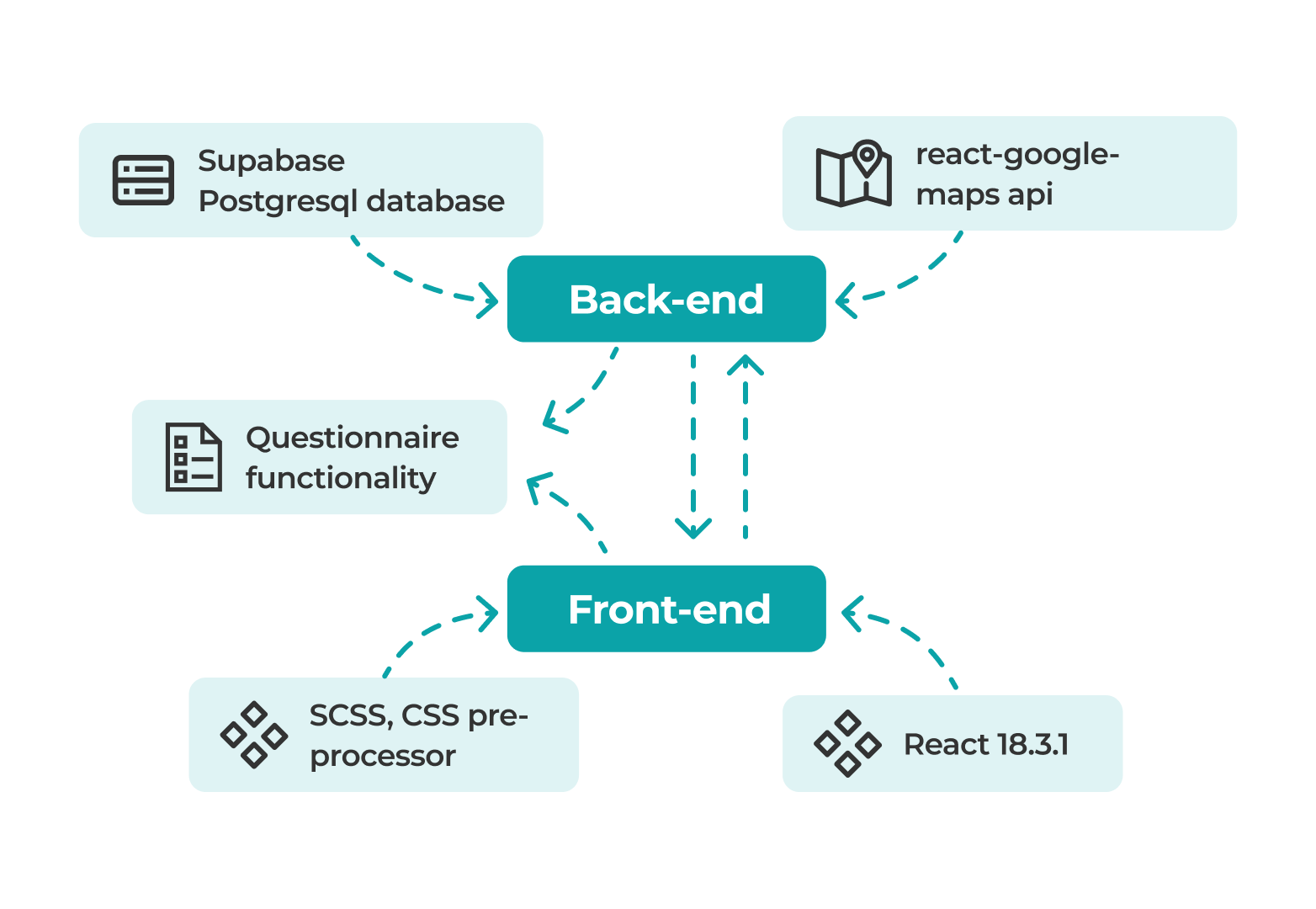
Maps API Integration: Real-time location requests provide walking directions via Google Maps API. Coordinates from our database calculate optimal routes, accurate walking times, and turn-by-turn navigation on an interactive map.
Tour Complete: What was Learned?
Balancing Uniqueness & User Needs
Finding the right solution that doesn't sacrifice user needs for uniqueness or vice versa was a core reason for TourWay's success
Identifying Scope Creep
It was neccessary to defend against scope creep early on and to readily combat it to prevent our project from becoming unfocused and impossible to finish
Inspiration from Varied Sources
While looking at similar products was helpful, it was also important to seek out inspiration for features in very different industries such as e-commerce and social media